Thoughts on Roger Penrose's book 'The Emperor's New Mind'
April 4, 2026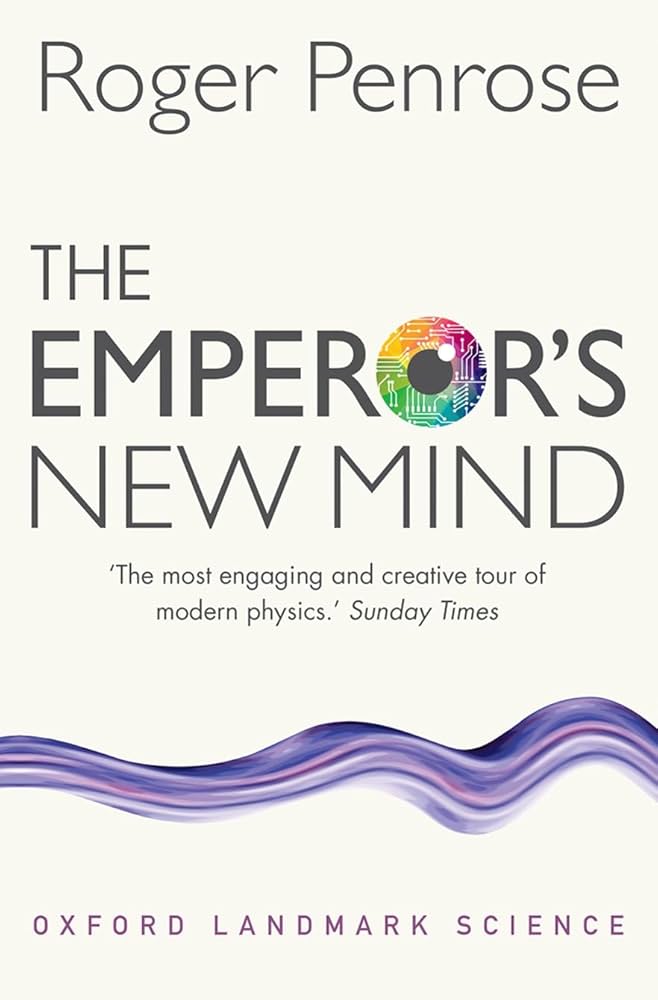
disclaimer: I might misunderstand some of Penrose's arguments and present them in my own biased view.
I recently read Roger Penrose's book "The Emperor's New Mind" and wanted to share some of my thoughts on it.
The book discusses some limitation of computers that based on the computational model of a Turing machine. For example, Gödel's incompleteness theorems show that there are true statements that cannot be proved by any formal system. However, the human brain can understand these statements and be convinced that they are true.
This discrpency between a Turing machine and the human brain suggests that there are more happening in the human brain that cannot be simulated by a computer. In this regard, one might wonder whether the current AI paradigm will be able to gain consciousness or sentience (whatever that means), as some distinguished AI researchers claim that they do.
Another interesting point that Penrose raise is the correspondence between the physical world and the idealized Plato's world. Penrose argues that rather than invented by humans, mathematical truths already exists in the Plato's world waiting to be discoverd. For example, the imaginary number $i$ was invented as a convenience tool to deal with the quadratic equation $x^2 + 1 = 0$. However, it turns out that $i$ is a fundamental part of various branches of mathematics and physics, e.g., quantum mechanics. Penrose also used examples of how mathematicians like himself first have a vague idea of a mathematical idea, and although the idea is vague, they are convinced that the idea is true and later on developed them into rigorous mathematical proofs. In some sense, at that moment, the human conscious has made contact with the Plato's world.
Recently I have been studying physics, and one thing I realize is that the physical laws that we used to describe the world are only limited to certain scenarios (all models are wrong, some model are useful). For example, Newton's law breaks down at high velocity, and incompatibility between general relativity and quantum mechanics. So, can the world ever be described by a mathematical framework? Or the best math can do is to approximate the world we live in. It seems to me Penrose argues that there is a mathematical truth waiting to be discovered that can explain all physical reality.
I myself tends to believe that there is a mathematical truth out there waiting to be discovered. Einstein comes up with his theory of general relativity based on the equivalence principle and the mathematics of differential geometry. The theory is not only elegant, but also makes remarkably accurate prediction and enable advanced technologies such as GPS. The success of general relativity makes me believe in the existence of this correspondence between the Plato's world and the physical world.
On a more practical side about how this relates to my research. Currently the field of legged robots is dominated by deep learning. They are extremely successful, I myself did my PhD in this area and it is arguably the best techniques we have. However, I do believe that model-based approaches such as model predictive control will eventually catch up, we just haven't found the right formulation yet.
Questions or corrections? Reach me at zxieaa@gmail.com.